|
|
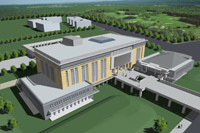
The pioneer period (1999 A.C.) Starting from the time before founding of the university, the preparatory office had paid much attention to the library and information center and listed the library and information center as the third priority among all the buildings of the university. After several planning meetings and careful reviews by a plurality of experts, scholars, and architects, the architect Huang Yu-Liang’s design drawings had been chosen, which consisted of modern style. The millennium founding period (2000 A.C.) This university is the first national university in Taiwan to integrate a library and a computer center into one organization. On February 1, 2000, professor Hong,Tzung-Pei of the electrical engineering department was appointed as the first director of the library and information center on the founding day of the university. It took extremely hard work for developing the center at the embryonic stage; not only the on-going planning of the library and a computer center should be carried on, but also a temporary library and information center in the size of nearly 1000 square meters located on the second floor of the First Complex Building should also be planned out in a very short period of time. Successively, the configuration of the school buildings, the purchase of books and journals, the automation, the campus network, the school affairs system, and the like, have been completed. The library and information center was opened to the whole school for its services on July 1, 2000. The organization structure of the library and information center comprises seven sections: the collections maintenance section, the acquisitions and cataloging section, the administrative services section, the networks and communications section, the application systems section, the multimedia production and audio-visual section, and the data and operation section. |
||
|
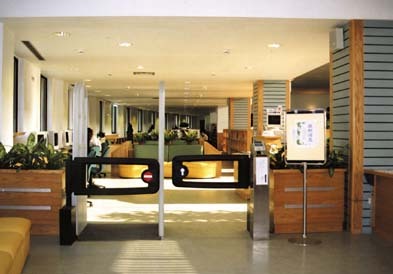
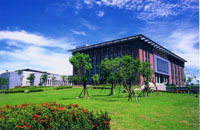
In the temporary center, there were book stack section, study section, reference books section, journals section, audio-visual section, search section, new book display section, service counter and office; in addition, five computer classrooms were planned (three have been completed), mainframe room, and office for the information technology section. Brilliant new center period (August, 2003 A.C.) On August 1, 2001, professor Shyu, Jong-Jy of the electrical engineering department was appointed as the second director of the library and information center. He supervised the architecture of the library and information center, planed the interior design and decoration of the building and furniture configuration, and completed the moving into the building. This building, a winner of the Chinese Golden Stone Award for Architecture, comprises two underground floors and six ground floors with total area of nearly twenty thousand square meters. The building was finished in February, 2004, moved in in July, and officially opened on August 1, 2004. It provided the brand new and comprehensive library and information services for the teachers, staff, and students of the school and started a new era of the library and information center of the university. Due to lack of an administrative building of the school, the fifth and sixth floors were used by the administrative units of the school. The library and information center utilized the first to the fourth floors of the building, which had more than thirteen thousand square meters of floor area. The first floor was planned for a study room, four computer rooms (two of them have completed), a mainframe room, an office, a conference room, a computer maintenance room (each of the other three teaching buildings also disposes a computer classroom). The second floor was planned for a service counter, a reference area, a new book display area, a newspaper area, a search area, an atlas area, a pamphlet area and an office. The third floor was planned for a journal area, audio-visual area, and a discussion room. The fourth floor was planned for a book stack area, research rooms, and discussion rooms. The library was planned to collect 400 thousand volumes of books. The reading seats were around 1000. The stable growth period (from 2004 A.C. until now) The university’s Administration Building was completed and occupied in April 2014. In 2016, with financial support from the Ministry of Education, the library’s 5th floor was equipped with new steel bookshelves and reading tables and chairs. The space was designated to serve once again as a library stack and reading area. During the summer vacation from July to August 2016, the setup of the 5th-floor reading area was completed, adding 108 new reading seats. The area was officially opened for use at the beginning of the 2016 academic year (from September 12, 2016). To comply with the university’s policy on organizational streamlining and manpower adjustment, the library was reorganized four divisions: Collections Maintenance Section, Acquisitions and Cataloging Section, Networks and Communications Section, and Application Systems Section. Two staff positions were reduced, aiming to deliver the highest quality service with minimal manpower. At present, the library’s collections and information facilities are becoming increasingly comprehensive. The volume of library holdings continues to grow each year with the Ministry of Education’s project funding support. In addition to traditional book lending and reference services, the library is also advancing toward diversified development through digitalization, networking, and multimedia integration.The Library and Information Center integrates the resources of the library, the Computer Center, and the Multimedia and Audiovisual Center to provide faculty and students with comprehensive and integrated services, including access to books, journals, the Internet, and administrative systems. These services aim to better support teaching activities and meet students’ learning and digital needs.Furthermore, the library is open to the local community, allowing external users to enter and utilize its facilities, thereby fostering a reading culture and promoting lifelong learning within society. |
|||